

Welcome to our new roughly-monthly letter (not newsletter, just letter). Each edition will be written by one of the Galileo partners.
What’s the story behind the name?
For those who haven’t had the joy, I mean pleasure, of studying computer science and algorithms, here’s the story behind the name.
The name O(n) × O(1) is a tongue-in-cheek reference to algorithmic time complexity from computer science.
- O(n) ("linear time") means work scales with the size of the problem—you have to look at every data point or company.
- O(1) ("constant time") means an operation takes the same amount of effort regardless of scale.
The joke is that great investing requires doing the O(n) work—deeply researching markets, founders, and technologies—so that when an opportunity appears, you can make what feels like an O(1) decision. In other words: put in the hard thinking upfront so conviction becomes fast when it matters.
What’s the point?
The idea of the letter is to be able to share what we’re seeing in the market. That might be macro, that might be micro. It could be anything, any length, and is intentionally left broad for each partner to interpret at the time.
I get the joy of writing first, so here we go.
————————————————————
I’m sorry, this is about AI. However, I want to be a little more philosophical in places, draw on theology (never thought I’d say that in a professional or even personal environment), and chicken farming.
My long-form writing is less frequently flexed than when I was in high school, so strap in.
While I am devastated that AI has ruined my love of using emdashes and a million sub-clauses, I did write the whole thing by hand. I did generate some images with the help of AI though, that’s too much work.
Masayoshi Son’s Golden Goose
It was impossible to miss the frankly astonishing slides presented by Softbank Group’s moderately unhinged but perhaps prophetic “Masa Son”.
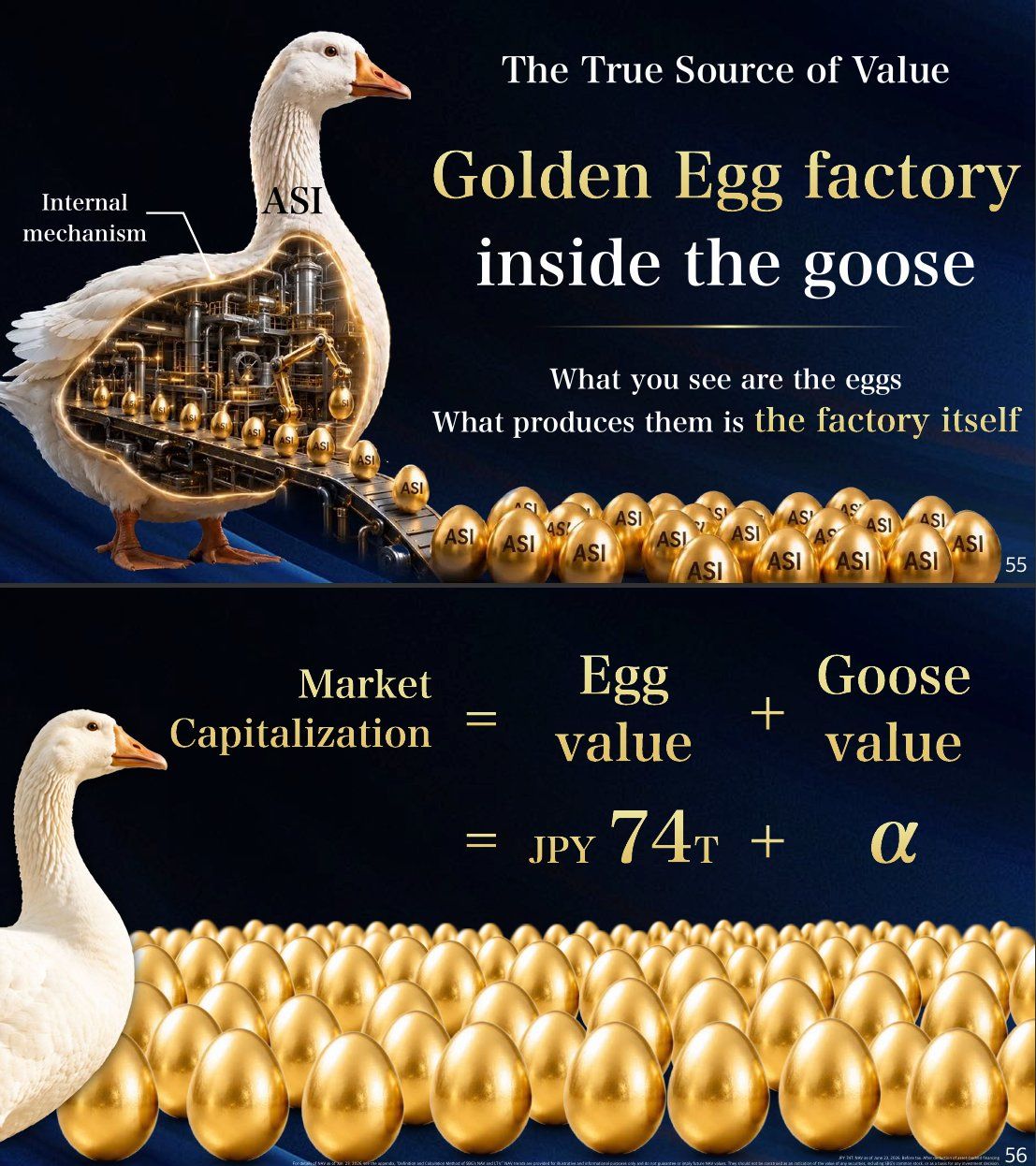
There’s an element of truth to this in the age of AI. That’s one of the reasons we are seeing so much enterprise value accrue to the foundational models under the assumption that they will represent the geese of the future.
I am a self taught software engineer, and like many operational founders, I love getting on the tools. Building “stuff” with Claude Code is frankly highly addictive. It’s magic and astonishing, but it feels like you have this magic intern who will just grind 24x7.
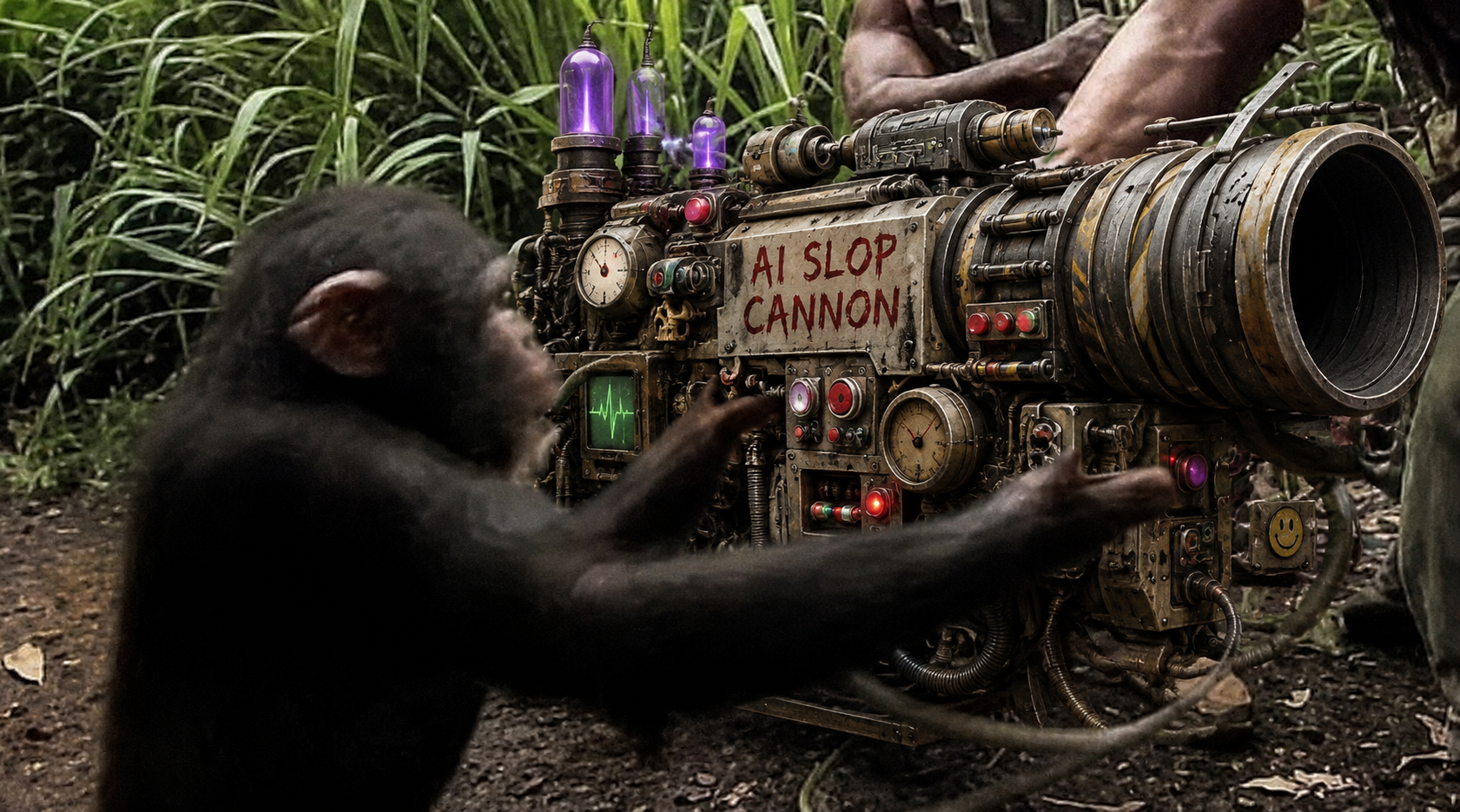
AI psychosis is real; it’s coming for us all
There’s this tension though which is impossible to avoid. With apologies to the Gartner hype cycle, the more I speak to other people about their experiences with AI, whether ChatGPT, Claude, Copilot or others, it feels like this.
I’m going to call this the AI adoption psychosis cycle.
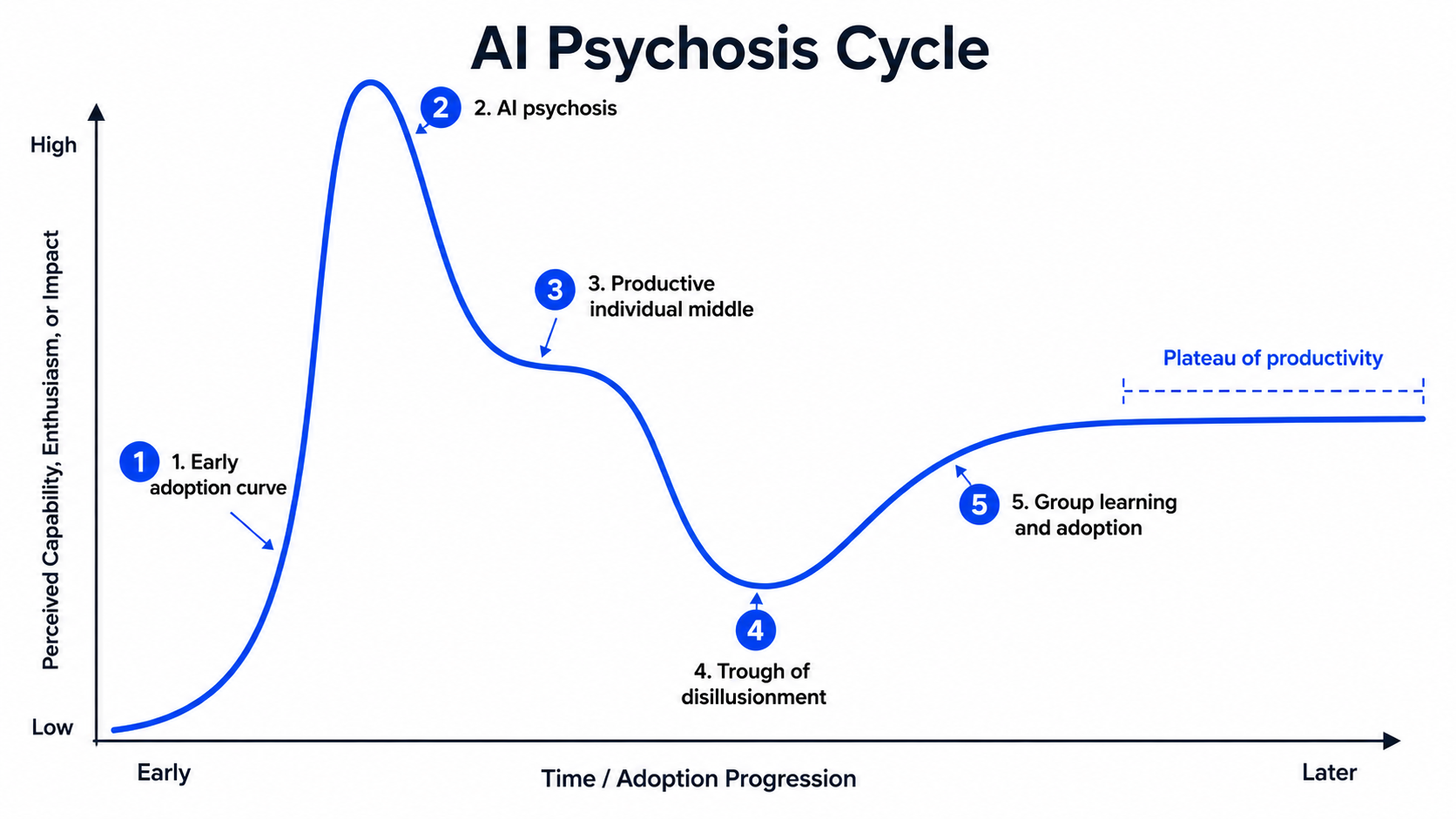
Early on, you’re in the (1) Early adoption curve. You chuck everything at it, most of the time it fails miserably, but you keep grinding. As your chosen AI learns more about you (“context layer”), and you learn more about how to best prompt it, you discover how much it can do.
Then you eventually hit full blown (2) AI psychosis. You want to have something running 24x7, in as many threads as possible. I’m often running 5 Claude Code’s in parallel and babysitting them!
But then after the first little while, when you get even more astonished at how good this is and how it is going to transform the world, you get this horrible nervous and anxious energy. Any time the AI isn’t running, your life is wasting away. What’s happening to those highly subsidised tokens if they aren’t burning all the time? I can do more. More productivity, all the time.
This is the true psychosis, and the key is to try and shoot through it and realise the times when you’re using the tool to be productive, and when you’re actually making the tool shaped objects mistake – the sense that you’re doing all this work because the tool is working, but you aren’t actually producing any useful outcome, let alone the right one.
It takes a while to balance out a bit, but then after a period of going insane, you end up in this sort of (3) productive individual middle. You spend your time showing people your amazing setups, flexing on your token use (subsidised, of course), telling everyone about how amazingly productive you are.
Then eventually though, you realise you and your AI aren’t sitting in a vacuum. Other people in your business will need to pick this up. What an opportunity to show them The Way And The Truth And The Life.
But they aren’t as AI-pilled as you. Even with your support, they have to go through the same early adoption process and curve, end up distracted doing busywork, and take a while to get to that productive middle ground.
They fall into the same mistake. Suddenly you end up with five million lengthy AI generated documents “for your review”, which are generic slop that honestly could be a 100 word summary. They’re proud of this amazing work they’ve done because AI can now do anything (!) but instead it’s just generating a whole bunch of busywork both for them and for you. It’s infuriating.
That drags down your productivity massively. You’re in (4) the trough of disillusionment. Why is it so hard? Why does it take them as long as you and why are they making all the same mistakes?
Is AI the bicycle of the mind or are we building the Tower of Babel?
In that sense, “learning AI” is a lot like a bike, where you just have to get on the bike and put in the work, falling over. While some good guidance certainly helps, studying for 5 years about how to ride a bike without riding one will not actually help you ride a bike THAT much faster.
This then asks the question though, is AI a bicycle, a tool that we can use well or poorly, or is it (now or in the future) something else?
The Pope’s Encyclical letter, Magnifica Humanitas, is actually a really good read (recommended easier version to read on a computer). I never thought I would draw on my [Anglican] religious schooling being a fairly staunch atheist even at school, but here we are. AI surprises us all.

I’m going to quote the first few sentences because I think they do a really great job of presenting the challenge we have ahead:
Humanity, created by God in all its grandeur, is today facing a pivotal choice: either to construct a new Tower of Babel or to build the city in which God and humanity dwell together. Each generation inherits the task of shaping its own era, of guiding history to become a place where the dignity of every person is safeguarded, justice is promoted and fraternity is made possible. Yet every era also runs the risk of creating an inhumane and more unjust world.
His Holiness Pope Leo XIV
Now, reader, if you are not familiar with the parable of the Tower of Babel, allow me to copy/paste from the Gemini AI Overview answer that Google Search gives me.
The Tower of Babel is a foundational biblical narrative from Genesis 11:1–9 detailing how humanity, united by a single language, attempted to build a city and a massive tower reaching the heavens. God intervened by confounding their speech, scattering them across the earth, and abandoning the project.
Gemini, lol
And this is the question! In the search and desire to create artificial superintelligence (I’ll call that “God”) are we, the tech “elite” (by nature of our access, our capital and to some degree simply our location in the world) building a massive tower to try and reach the heavens?
Yes, probably.
Will we safeguard people’s dignity, maintain justice, and avoid further fracturing society? Hopefully.
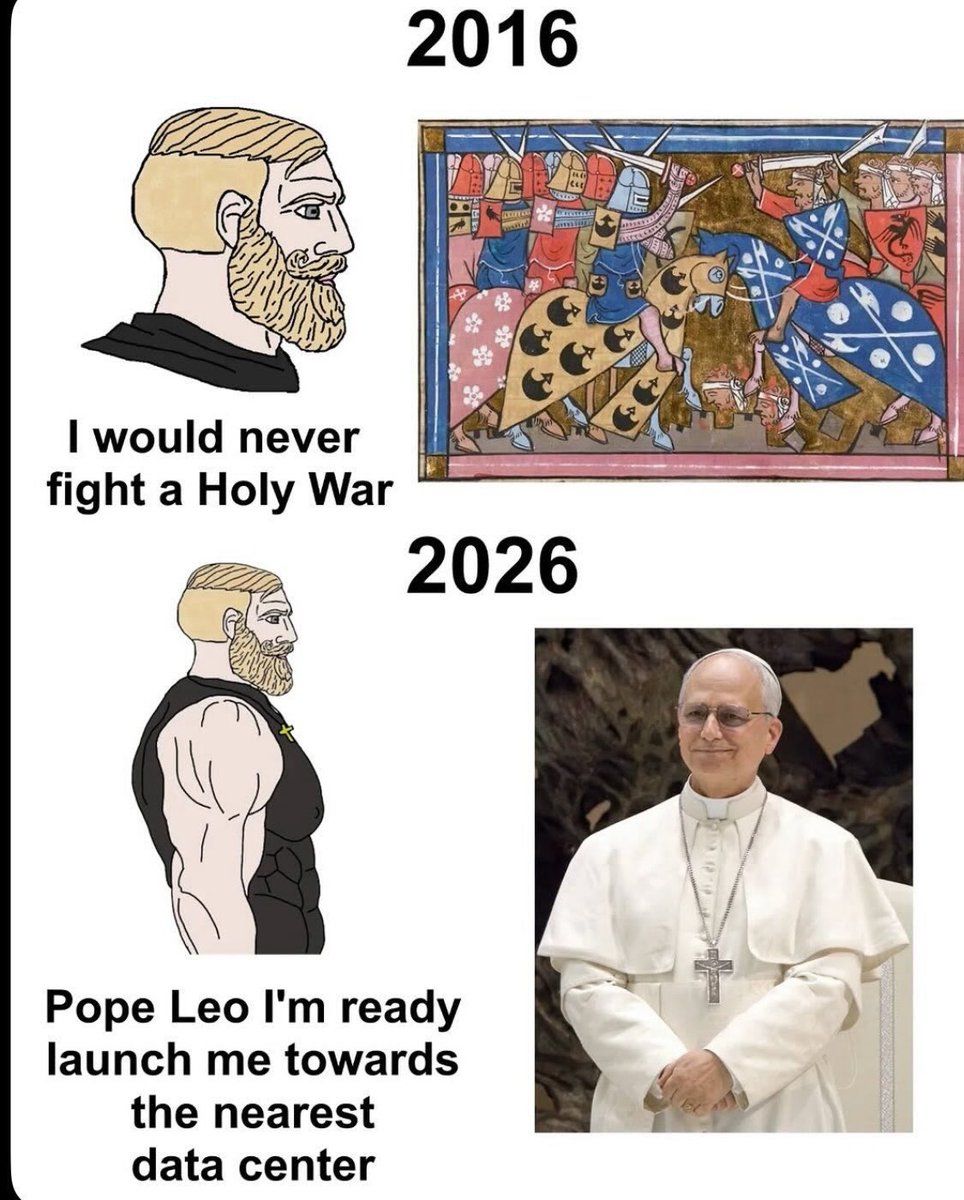
I won’t – in this letter1 – pontificate (ha.ha.) about what exactly consciousness is or is not and whether AI is conscious, now or ever. I’m still not quite sure how I’d define the singularity, despite being an avid science fiction reader. Perhaps in a future letter.
The main thing though is that the solution is not confounding and abandoning. Pandora’s box is already wide open and we are only getting a glimpse in.
So in the macro global context, what should Australia do? One thing is for sure, the answer is not nothing. You can’t open the Financial Review without having your face blasted with AI in amongst news about the death of property (and everything else) as an asset class.
But first, a sojourn into regulation.
Risk-based regulation and protecting the public
A perhaps lesser-known fact is that when I was a consultant, and briefly even an employee, I worked for a national regulatory body.
Something we talked about frequently was that the role of regulation is to protect the public at large, who may (like the monkey above) not always be aware of what they’re being given or what is “right” or “wrong”.
The other part though, and the challenge of regulators as with government policymakers, is that regulation has to be risk based. It was not about arbitrarily enforcing rules for the sake of them.
Indeed many complaints were from competitors who were making a complaint about a rule that they had often mistakenly broken, seeing many others making the same mistake intentionally or otherwise. Thankfully these were often minor in terms of risk to the public.
The perception was that the regulator was a cop, throwing our weight around all the time. But having seen a number of the matters where there was indeed risk to the public, sometimes a metaphorical Judo throw is needed.
The little [economic] engine who [perhaps] could
In amongst a global melee of everyone, regulators and politicians included, trying to work out what the hell this AI thing is and what the future will hold, we have Australia.
Beyond digging stuff out of the ground, we have great resources in this country despite having a comparatively tiny population.
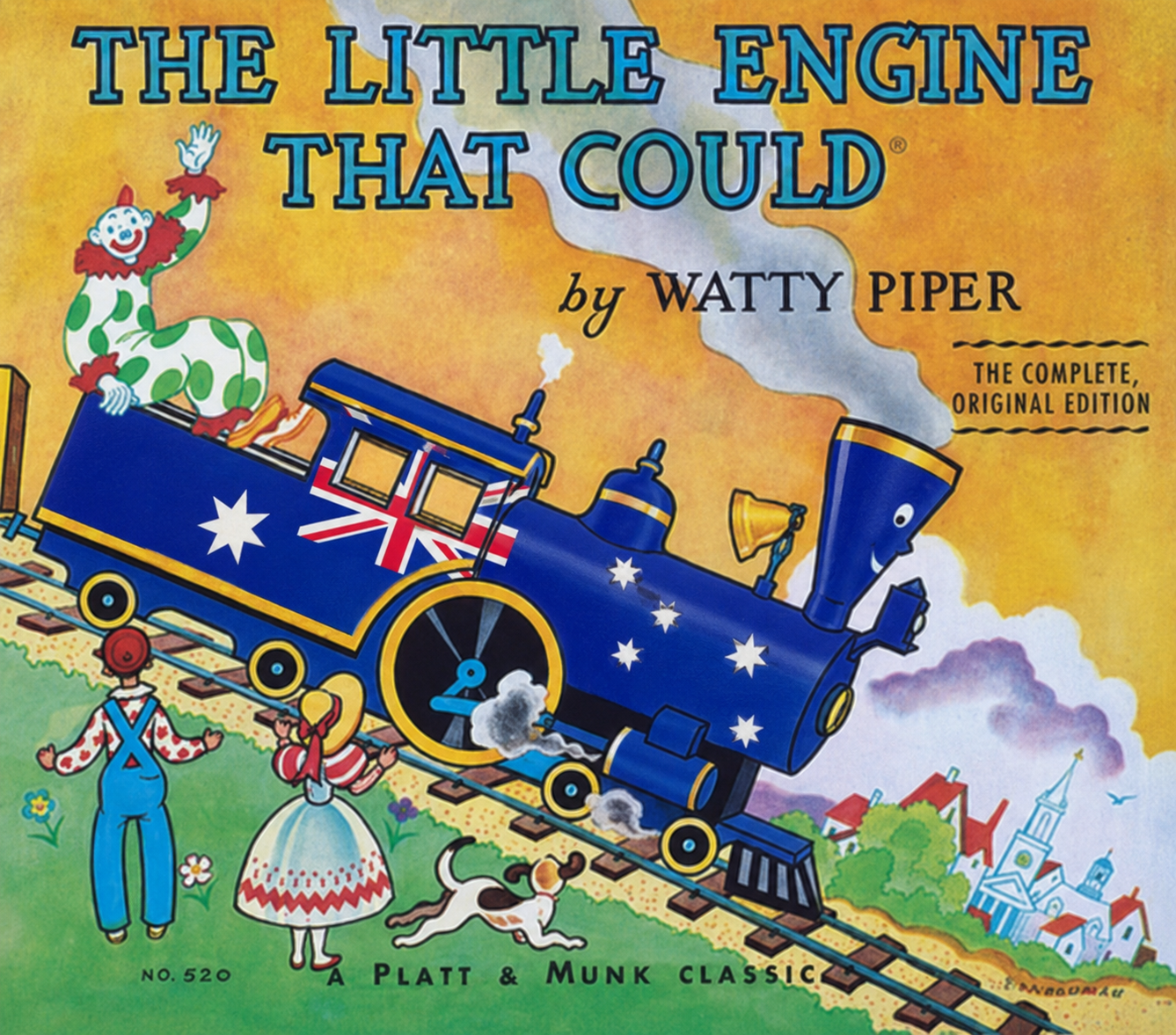
Australia has some clear advantages. The potential to generate a huge volume of renewable energy.2 Fantastic education. A very buy-local consumer and business population. Proximity to Asia.
However there are all kinds of downsides. Our labour market is challenging for employers and “expensive”. Our blue collar population can make as much as a mid-level engineer doing FIFO work in the resource sector. The middle class of the 80s and 90s has led to a retiring workforce and older population.
The thing I’m going to really gripe about though, is our policy landscape and the way we are frankly setting ourselves up to fail and end up squandering the opportunity.
Are we dooming our children to use Microsoft Encarta?
I was young when the internet revolution happened,3 but I remember at school being told you could not use that awful Wikipedia thing as a reference.
You needed to search (by hand!) the Encyclopedia Britannica at the library. The more privileged of us could take Age of Empires out of the family Pentium 1 desktop and put in Microsoft Encarta. A real multimedia experience4, including the world’s knowledge on a 700mb disc.
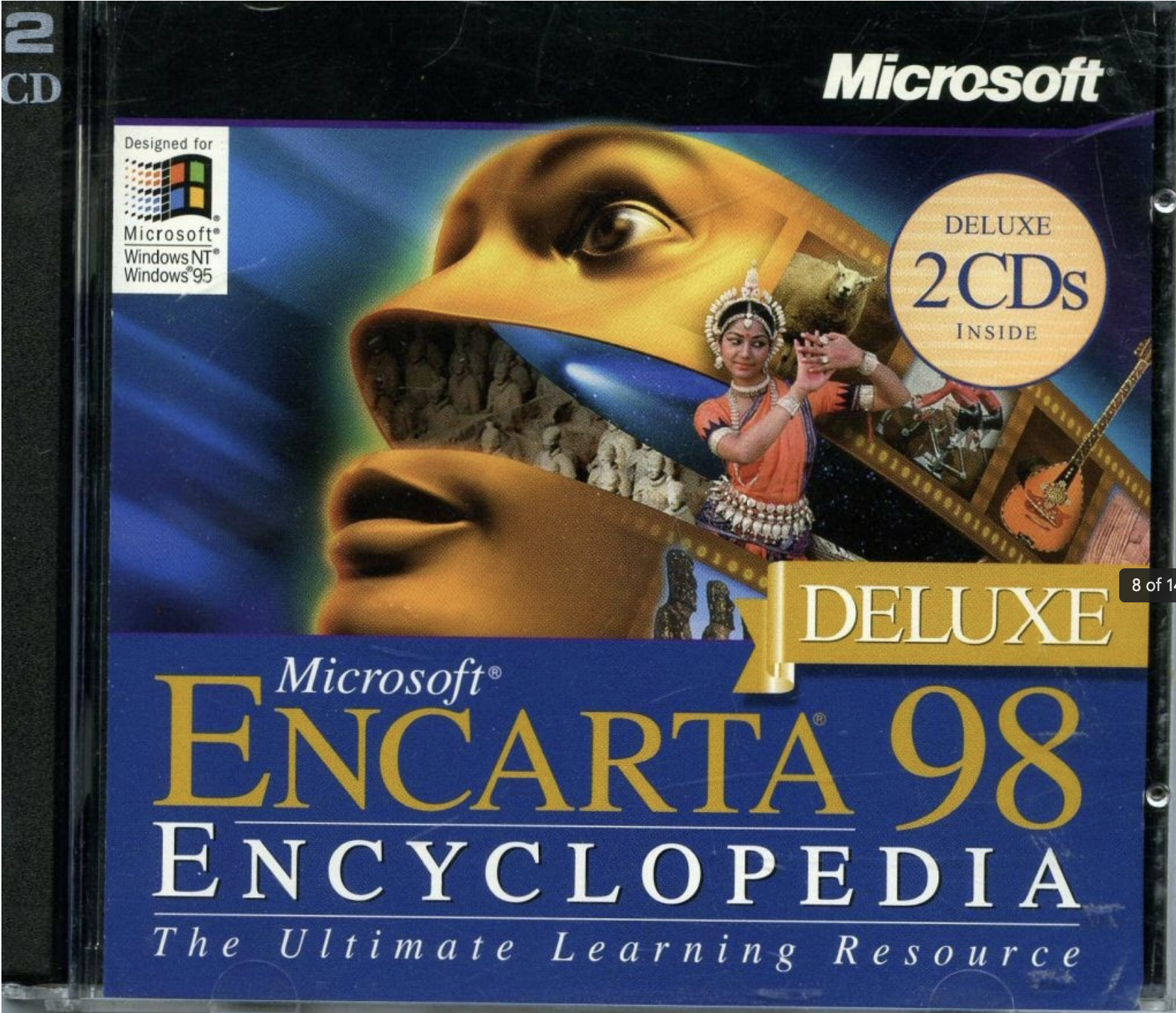
We all know how that story ended. You can probably now only find copies of Encyclopedia Britannica shelved in lawyers’ offices pretending to be important legal tomes.
Will Australia be left in that past, the one filled with crusty earmarked copies of ancient history and discussions of the information superhighway?
I am not holding my breath.
Australia’s battery hen policy stance
Pushing the already-stretched golden goose metaphor well beyond its breaking limit, I’m worried we will end up with a battery hen instead.
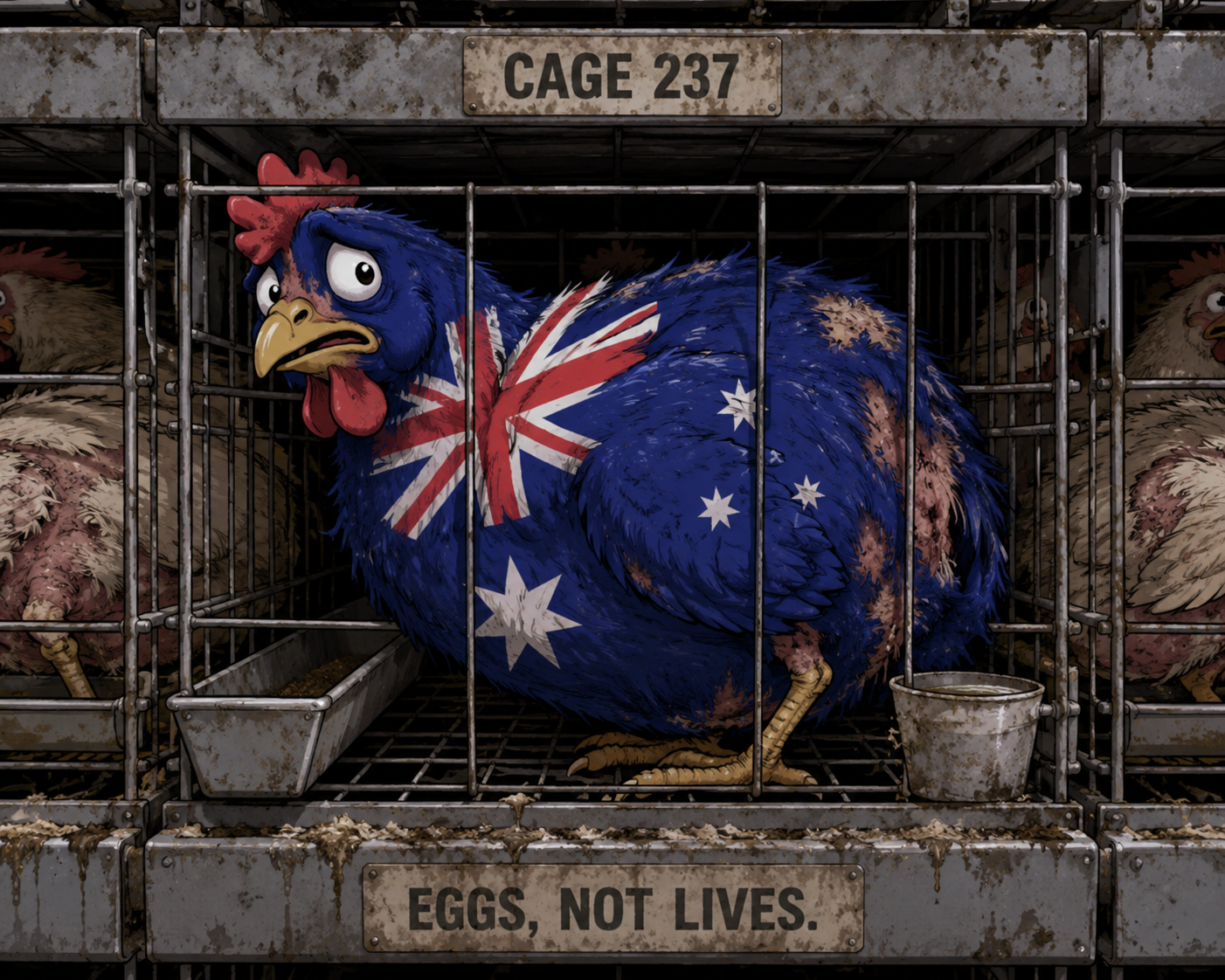
Our huge own goal of tobacco taxation policy should be the canary in the [Australian] coal mine.
Similarly, our insane-to-me-but-polls-great-with-parents policy of banning under 16s from social networks has been another abject failure.
Everyone knew Net Nanny was only moderately successful at keeping a determined kid away from things on the internet when I was a kid, and instead of parent-driven software we’ve tried to police ourselves into compliance.
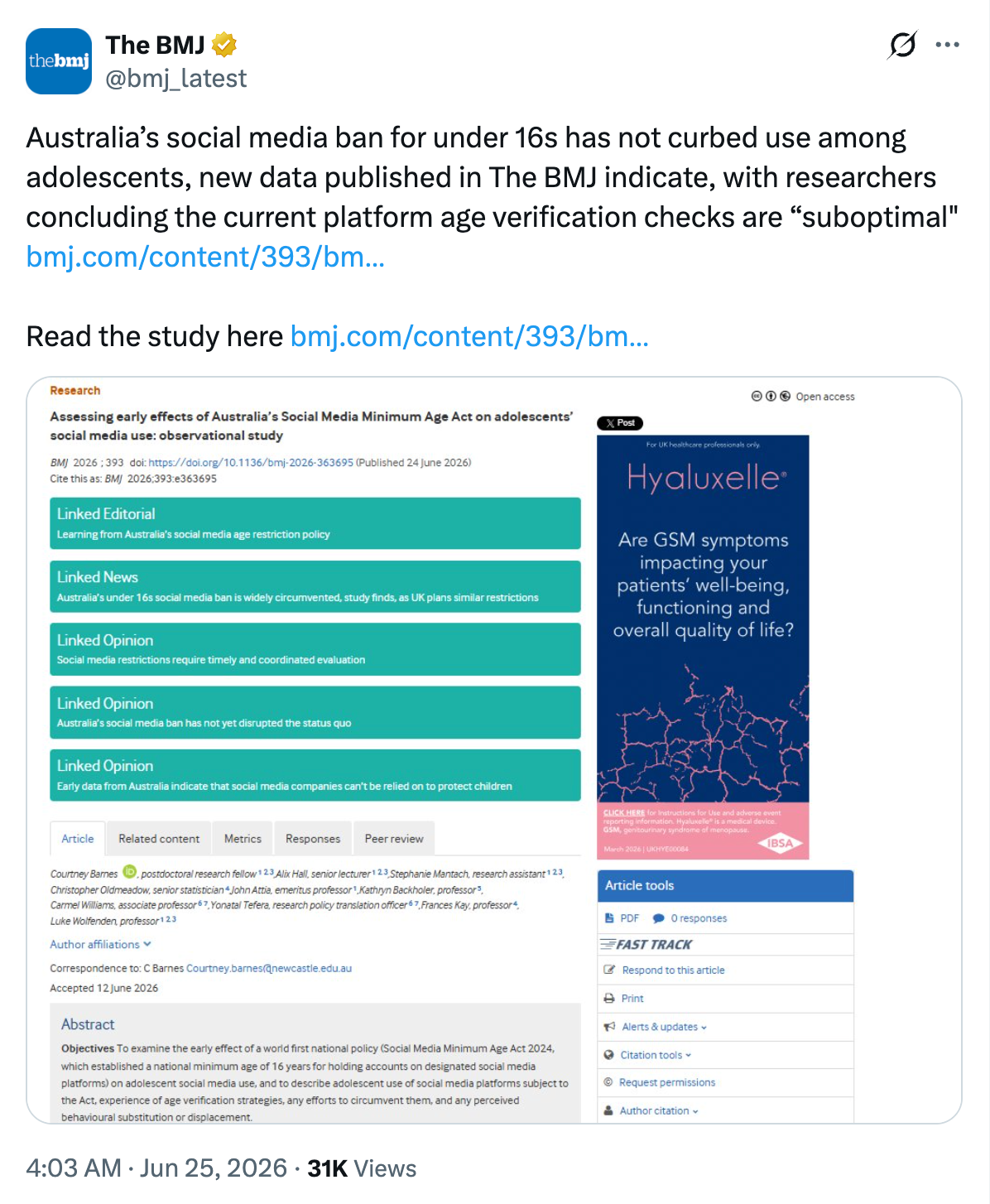
What next? We’ll build a Great Firewall5 to keep Australians safe? We’ll go the way of Europe and demand everyone build cookie banners and be a laughing stock?
I ultimately came up with the overall theme of this from a semi-satirical piece about Europe’s role in AI titled Europe 2031. It tells a story of what it means to get AI wrong, starting on a [protectionist] policy level and flowing onto pretty much everything else.
In many ways Australia keeps making the same series of mistakes. Even then, unlike Europe we don’t even have the population size to really sustain a protectionist approach under some kind of sovereignty and hope-nobody-will-look-outside belief system.
Unlike countries like South Korea or Taiwan, we don’t have much by way of even a “picks and shovels” economic role in the AI boom. At best you can argue for our role as a rare earths resource nation but if that’s the case, we’re already doomed.6
A spoon full of concrete [policy] helps the medicine [AI] go down
So we’re in trouble. We need to do something. So what?
To give the holistically unsatisfying answer, I am not sure what would get across the political divide in this country, nor if we have the leadership that would push on regardless.
With that caveat aside and ignoring what is the abject reality of political decisionmaking, here’s what I would be doing on a policy front.
(1) Energy as the foundation, as renewable and fast as possible, with a welcoming approach to nuclear
No matter how much efficiency will inevitably be driven over time, we are going to need more power.
Renewables is something Australia already thinks it does well, and perhaps we do, but it needs to be connected (if not local) to the right places. We already have our “gold-plated poles and wire” infrastructure investment so let’s make good use of it. In many ways I think that Australia is pretty encouraging of this renewable cornerstone.
My more controversial policy stance is that I think we should welcome new approaches to nuclear energy. With a concentrated effort we won’t be taking 50 years to stand up a plant, and many companies are already working hard on that challenge.
We need to be open to the idea of creating friendly policy for these new approaches (fusion, small modular reactors, …) to develop and flourish.
That can still be done within a safe-to-the-public framework, and can draw on some of our geological advantages of mining much of the world’s nuclear material plus obvious benefits like not being on a tectonic fault line.
(2) More data centres and more long-haul data pipes to key partners
The fact that aeroderivative generation7 exists and that many new data centres are being built out almost electricity-grid-disconnected until utilities can be connected in 3-10 years is wild.
Data centre policy has a bit of a gotcha that the build out employs a lot of people8, but when it’s up and running far fewer. That can make it pretty unpopular in some ways, but that’s unavoidable.
We need clear policy to make it easy for data centres to be built given Australia’s regulation-heavy approach at multiple levels to development approvals. We need to push aside the NIMBY voters who will probably be dead by the time the AI revolution fully arrives and build for the future.
On a more detailed basis, Australia is unlikely to be a centre for edge compute and real-time inference. We’re far from everywhere, and beyond year 7 science you need only look at gamers in the bush to see that the latency issue is real to much of the world.
But there is still a lot of asynchronous compute that needs to happen. In the short term much of this is training foundation models. As the economic realities shift and people or business has to start grappling with the reality of token cost, many of the things we are doing “now” will instead later be pushed into asynchronous processes.
I’ve seen this first hand and indeed the major model providers already have ways to use asynchronous batch-based processing at hugely discounted per-token price.
Shifting AI-driven things that can be stored and recalled easily to asynchronous approaches is actually not hard once identified and means we can smooth demand. That’s the kind of role we can easily play, as latency becomes less of an issue.
(3) Encouraging people to start companies with long-term horizons
Unsurprisingly I think we need more entrepreneurship in this country. I’m going to qualify that though. We need long-term-horizon entrepreneurs.
I define that as someone who wants to build a generational company, someone doing what they think is their life’s work. You don’t do your life’s work in 3-5 years. It’s not a get-rich-quick scenario even if some people manage to make it one.
Speaking to most successful or otherwise founders and entrepreneurs I know, there’s no overnight success and those who think otherwise disappear quickly.
It’s interesting talking to people about what that means for me as a fund manager. Something that returns (if things go well and as expected) a quick 3-5x is probably actually a bad investment for us9.
It’s not the business model. The advantage and sometimes disadvantage of venture capital is that you need to be patient and understand great things take time.
Much of the institutional venture capital sector is already oriented toward this already as our business model requires it. Founders also need to be educated and understand the importance of finding the right partner who has the right capital model (horizon, risk) for their business without trying to ram a square into a round hole.
(4) Shifting the focus and role of the ASX
The last idea or “thought grenade” I’ll drop in your lap is the role of the local stock exchange. We know that our ASX100 or 50 is heavily dominated by our banks and resource giants but why does that need to be the case?
Tech goes to overseas exchanges because it “isn’t understood by local investors”, particularly for the regular investor used to instead punting their money on smallcap mining explorers.
That could easily change though, firstly through dual listings until things catch up and the credit market becoming better developed locally for innovative companies in a market addicted to franked dividends.
There’s a lot of steps in there, and it is the kind of approach that will be costly (socially? Economically?) to the first few who take the leap.
It’d also be great to see mid- and even small-cap tech stocks that are not frankly awful available to public investors.
In the meantime you will need to invest privately in funds like Galileo 😉.
Finding the right orientation
Oriented the right way, I’m excited for our country. If I wasn’t, I’d probably try to leave and be part of the brain drain.
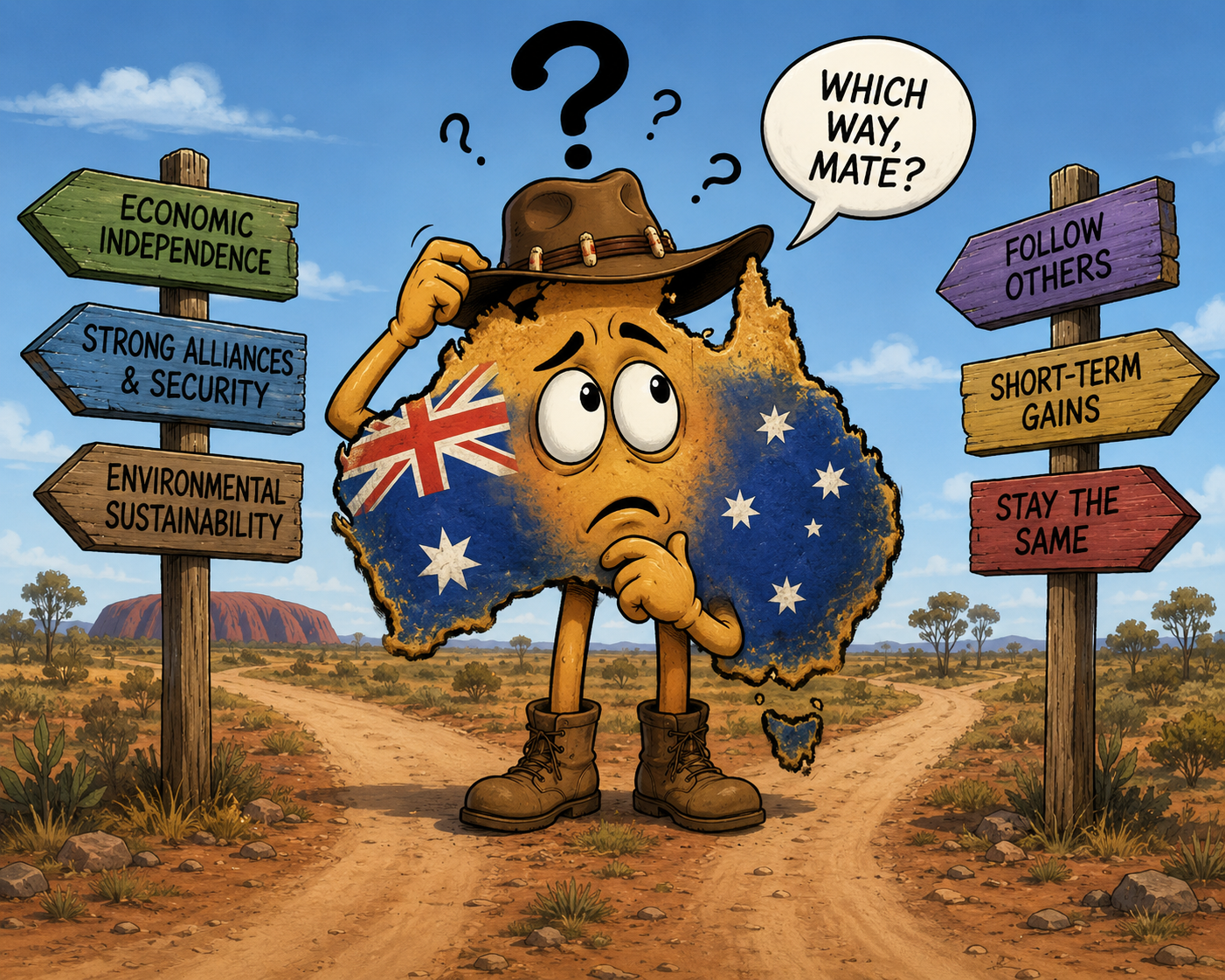
The orientation is the hard part. It’s a Sisyphean task to shift culture and our collective mentality.
That needs to be driven firstly by those most knowledgeable, the technologists, but we need to accept and perhaps even embrace that the rest of society needs to be brought on the journey with us, which will bring a similar AI journey to what we have had.
We need to be bold and brave in our policy. We need to focus on where things will be in 10, 20, 30 years from now even if it is challenging if not impossible to predict.
We need to decide where we are going to play and where we aren’t, and that needs to be aligned to our strengths rather than some utopian view of Australia having a more important role than we ever have in the past.
And finally, we need to work out a way to have these debates in a constructive way focused on the same goal, fostering and developing the incredible businesses of the future to maintain their local ties.
A brief aside on length, and an implicit apology to the reader
Finally, please do not expect these letters to usually be this long.
My fund partners will kill me.