Announcing our US$350k investment in Fluent BCI
Our pre-seed investment in Fluent BCI, a brain-computer interface company using AI to translate intended speech directly to text.

AI will help solve some of the most critical medical challenges we face. The brain remains one of the least understood frontiers, and AI can teach us how to better harness it — unlocking a higher order of thinking and living.
Fluent BCI is bridging that gap between the brain and our ability to reach its full potential with their recently announced $2m pre-seed funding round.
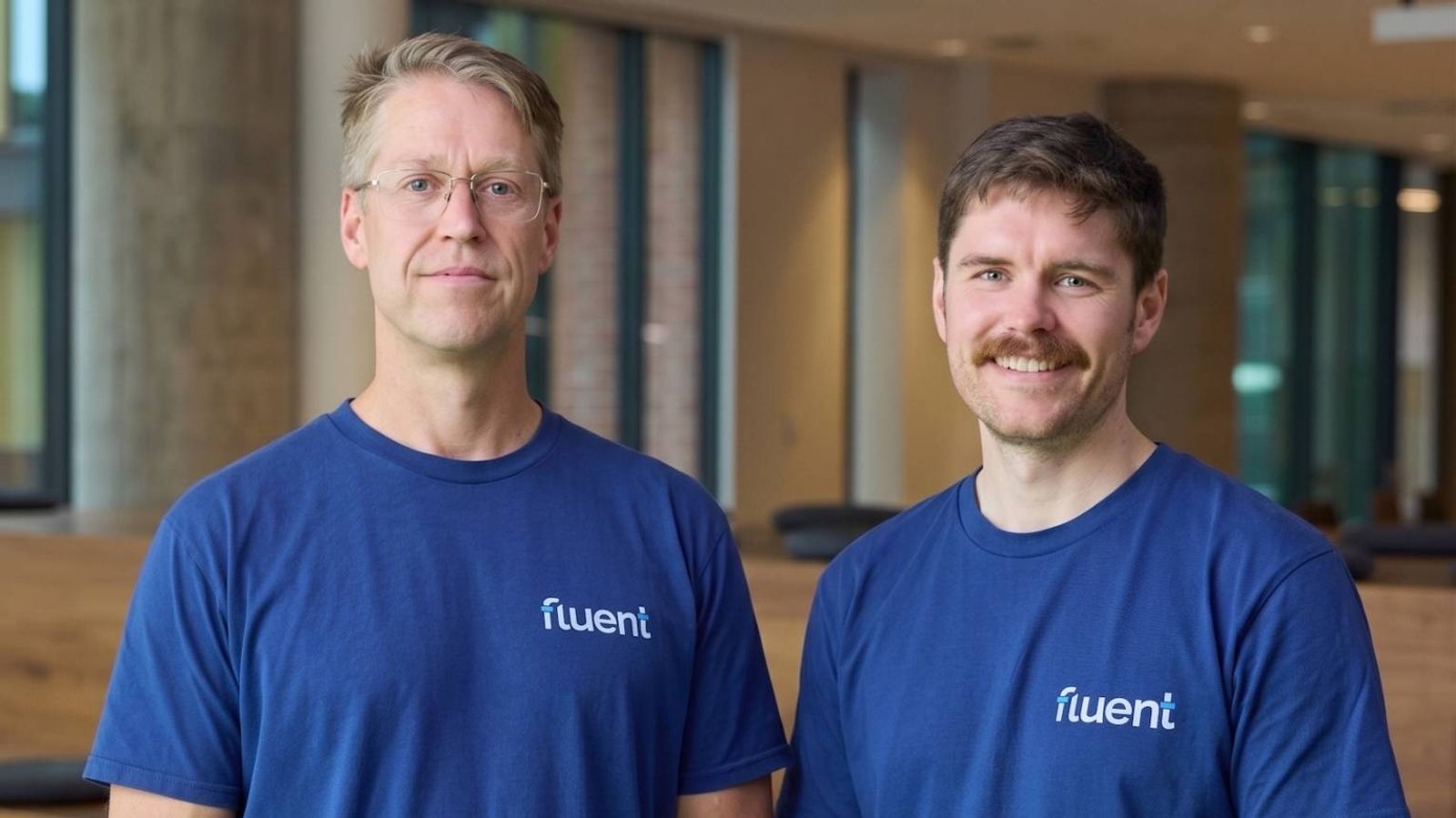
We have the greatest privilege as investors in emerging founders to back incredible and brave teams that are at the frontier of some of the most future critical technologies. We are very excited to partner with Fluent BCI. Tim and Dean are the type of founders we feel privileged to back in their mission to untap the brain and its innate power for all.
Hugh Stephens, Co-Founder and General Partner at Galileo Ventures
Believing in what could be
Alongside the AI revolution that is currently well under way, there will be an inevitable shift in the way that people interact with technology. As we rapidly shift toward digital agents and physical robots engineered to handle our complex tasks, a bottleneck becomes apparent in how we communicate and engage with technology.
Tim and Dean want to fundamentally change the way people interact with technology. Brain-computer interfaces open a higher fidelity channel of communication between humans and these automated systems.
Rather than acting as a tool, this deep level of interaction integrates the technology as a natural extension of our own capabilities. Fluent represents a revolutionary evolution in human connectivity, which is why it's so exciting. While the Fluent team is starting in an area that needs this technology most — patients who have difficulties with speech due to a neurological issue — we think that this technology will inevitably reach the wider population as well.
We believe that Fluent BCI can multiply the power of AI, further amplifying creativity and productivity by increasing the speed and decreasing the friction of interaction.
Fluent BCI isn't playing small
Fluent BCI isn't just restoring speech; they are creating a seamless, frictionless bridge between the human mind and digital intelligence.
Building a brain-computer interface (BCI) with the philosophy “Intelligence over Invasiveness” isn't easy, and one we feel needs to be brought effectively to market. Most emerging BCI companies are developing high-risk devices to detect brain activity, placing electrodes inside the skull (“intracranial”). This approach is not accessible to the broader population of people with disabilities who could benefit from the technology, let alone the consumer population.
Because of the high risk involved, intracranial technologies face a lengthy and costly regulatory journey, forcing users to wait more than a decade to access them. Fluent BCI operates in the “Goldilocks Zone.” Their device, InScribe, is a subscalp insertable BCI that sits outside the skull just beneath the scalp, and can be implanted in a 30-minute outpatient procedure.
The technology is only possible thanks to advances in AI capability, which will be built into the product from the start. InScribe will combine brain activity, multimodal context, and personal information to decode the user's intent.
By having a contextual “prior,” the model doesn't need to guess from the entire English dictionary. If the context engine knows you're at a coffee shop with a friend, it constrains the decoding probability space to the most likely conversational outcomes. By using a Class II regulatory pathway, Fluent can scale this in a way that simply isn't possible for more invasive systems.
How does this sci-fi device really work?
Fluent BCI's flagship neural interface, InScribe, decodes intended speech directly from the brain and translates it into text or synthesized speech in real time. Tim and Dean are essentially engineering telepathy by creating a silent, high-bandwidth communication channel between the human brain and the digital world. The initial focus is restoring human connection to patients with severe speech impairments. Their ultimate goal though is far broader: to build a frictionless interface that allows humans to interact with AI at the speed of thought.
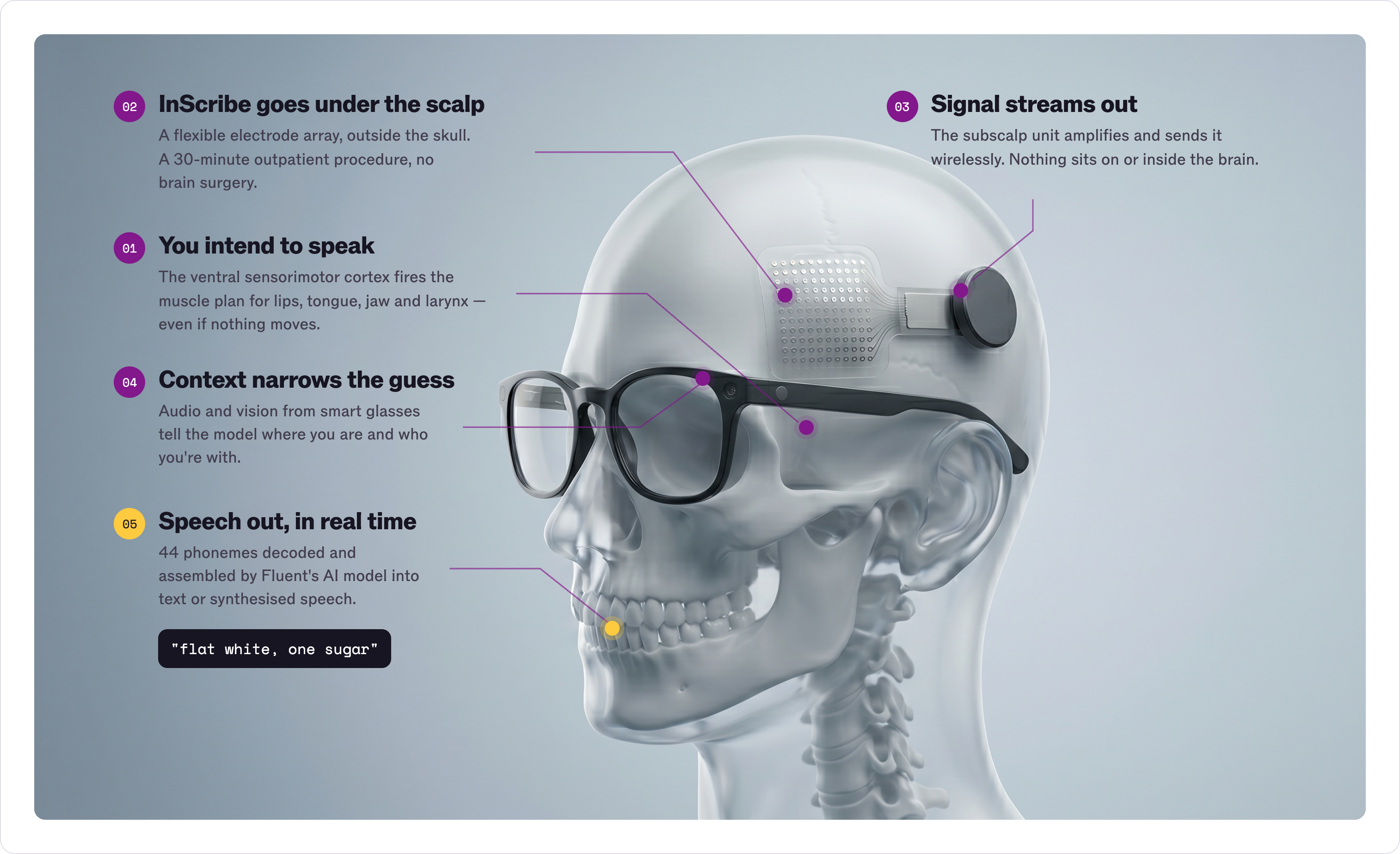
Under the hood, InScribe captures signals from the ventral sensorimotor cortex (vSMC), which is the highly specialized brain region responsible for orchestrating the muscles used in speech, such as the lips, tongue, jaw, and larynx. Targeting this specific motor pathway has a subtle but profoundly important consequence. Users must actively intend to speak for InScribe to register a signal. Because they are decoding the brain's downstream motor commands rather than its upstream cognitive processes, the user's internal monologue remains entirely their own. They are not, and literally cannot, read people's secret background thoughts.
The vSMC is a highly organized region of the brain featuring a precise somatotopic map. This means there is specific, dedicated neural real estate controlling each distinct speech muscle. For example, one anatomical location in the vSMC controls the tongue, another drives the lips, and another modulates the larynx. By sensing the localized electrical activity across this map, InScribe can pinpoint exactly which vocal muscles the brain intends to activate. Critically, these neural motor plans are generated even when people only silently imagine speaking.
Speech sounds, scientifically known as phonemes, are produced through the rapid and highly coordinated activity of multiple vocal muscles. For example, articulating a “da” sound requires relaxing the lips while activating the tongue. Conversely, forming a “ba” sound requires lip activation while the tongue remains relaxed. Because of the strict spatial organization of the vSMC, these differing mechanical requirements translate into entirely distinct neural activation patterns. The consequence is that every spoken, or imagined, sound generates a unique, measurable pattern of electrical activity across the cortex.
There are 44 phonemes in the English language. These serve as the fundamental building blocks from which all spoken words can be constructed. Every single phoneme is the result of a precisely timed combination of muscle activations, which is in turn driven by a unique spatiotemporal pattern of electrical activity in the vSMC. Successfully decoding these 44 distinct neural patterns gives us the ability to reconstruct the entire English vocabulary directly from the brain.
The core engineering challenge is therefore sharply defined. They must build a system capable of measuring and classifying these 44 distinct spatiotemporal patterns of electrical activity across the vSMC. Crucially, this decoding must be executed in real time, whilst maximising patient safety and long-term reliability.
Both academic researchers and competing startups have successfully demonstrated that it is possible to decode these 44 patterns by placing invasive intracranial sensors under the skull directly on, or inside, the brain. However the fundamental problem with this methodology is its unacceptable safety profile. Implanting these arrays requires open brain surgery, carrying significant clinical risks such as infection, neuroinflammation, and long-term tissue scarring.
Conversely, researchers and other startups have attempted to decode speech non-invasively by measuring the signals from outside the scalp on the skin surface. While these approaches are entirely safe, these non-invasive systems are highly susceptible to motion artifacts and environmental noise — not to mention often requiring the patient to shave their head. They also require complex setups in controlled laboratory environments, rendering them completely impractical for daily use.
The neurotech industry has historically been trapped in a strict dichotomy. At one extreme, intracranial devices offer high signal reliability but unacceptable clinical risk. At the other extreme, non-invasive sensors offer perfect safety but inadequate real-world performance. This is where Fluent changes the paradigm. InScribe is uniquely placed in the middle ground with the best of both worlds, reliably capturing the neural signals while maintaining an extraordinary safety profile.
Fast-forward to today, and the critical question naturally becomes: what accuracy can InScribe achieve at scale?
While they are still actively charting the upper performance limits, the trajectory is becoming clear. By leveraging compounding advancements in artificial intelligence, Fluent is expected to achieve the decoding performance that had been historically reserved for highly invasive BCIs, all without ever breaching the skull.
Why now: market trends and how Fluent BCI leads
We believe Fluent is taking advantage of three powerful trends in AI, converging on the exact problem they're solving.
Trend one: AI decoding follows a predictable scaling law
The first trend is the highly predictable scaling law of AI decoding models. Much like traditional speech recognition, neural decoders follow a power law where the error rate drops by roughly fifty percent for every tenfold increase in training data. A core advantage of Fluent's approach is that we can closely emulate subscalp signals using ultra-high-density scalp EEG in their own labs. This lets them gather huge volumes of proxy data to train their models without the regulatory delays and long timelines of implanting devices in people.
Trend two: multi-modal environmental data
Just as major technology companies rely on contextual data to predict user intent, the team is utilising environmental context and awareness to significantly boost decoding accuracy. By ingesting real-time audio and visual data streams, captured through peripheral devices like smart glasses, they can provide their AI models with far more context. The team has already shown enhanced context improves the model's ability to accurately resolve the user's intended speech.
Trend three: the generative AI revolution
At a fundamental level, large language models (LLMs) are exceptionally powerful statistical engines designed to predict the next word or token in a sequence. By integrating these models into their systems, they can decode neural signals as inputs that the LLM intelligently autocompletes and error-corrects based on strict linguistic probability.
Why we think it is important for humanity
At Galileo we are dreaming of a future where communication with each other and technology feels like thought, and Fluent is building the intent streaming platform to do it.
We believe Fluent's BCI product, InScribe, will provide frictionless real-time speech decoding without major surgery, and eventually remove the barriers between intent and execution for everyday users at the speed of thought.
The vision is that this high-bandwidth connection with AI will facilitate solutions to the most pressing problems facing humanity.
We're excited to be on this journey and backing Fluent BCI.
Keep reading.
 BackedAnnouncing Our Investment in BugsterAnnouncing Galileo's pre-seed investment in Bugster, AI-Powered End-to-End Testing & QA Automation for Enterprise.
  BackedAnnouncing our Investment in IsaacusAnnouncing Galileo's pre-seed investment in Isaacus, the first foundational legal AI research company, building sovereign AI models and tools for law.