
Hello builders,
The times they are a changin’ and so are startups. We see more founders pitching us than ever before and in this letter I want to take a look at our startup funding application data and reflect on what’s changing.
We ask founders to fill out a ‘quick application’ to get in touch with us as a fund. We have found this gives founders more equitable access to the team as all partners will see your deck and it saves everyone time. Some might think we see less of the “good stuff” — in fact we see everything. Which has shown us that perhaps the proverbial coffee meet isn’t the best way to go.
More applications, more AI, more traction, more GPTs
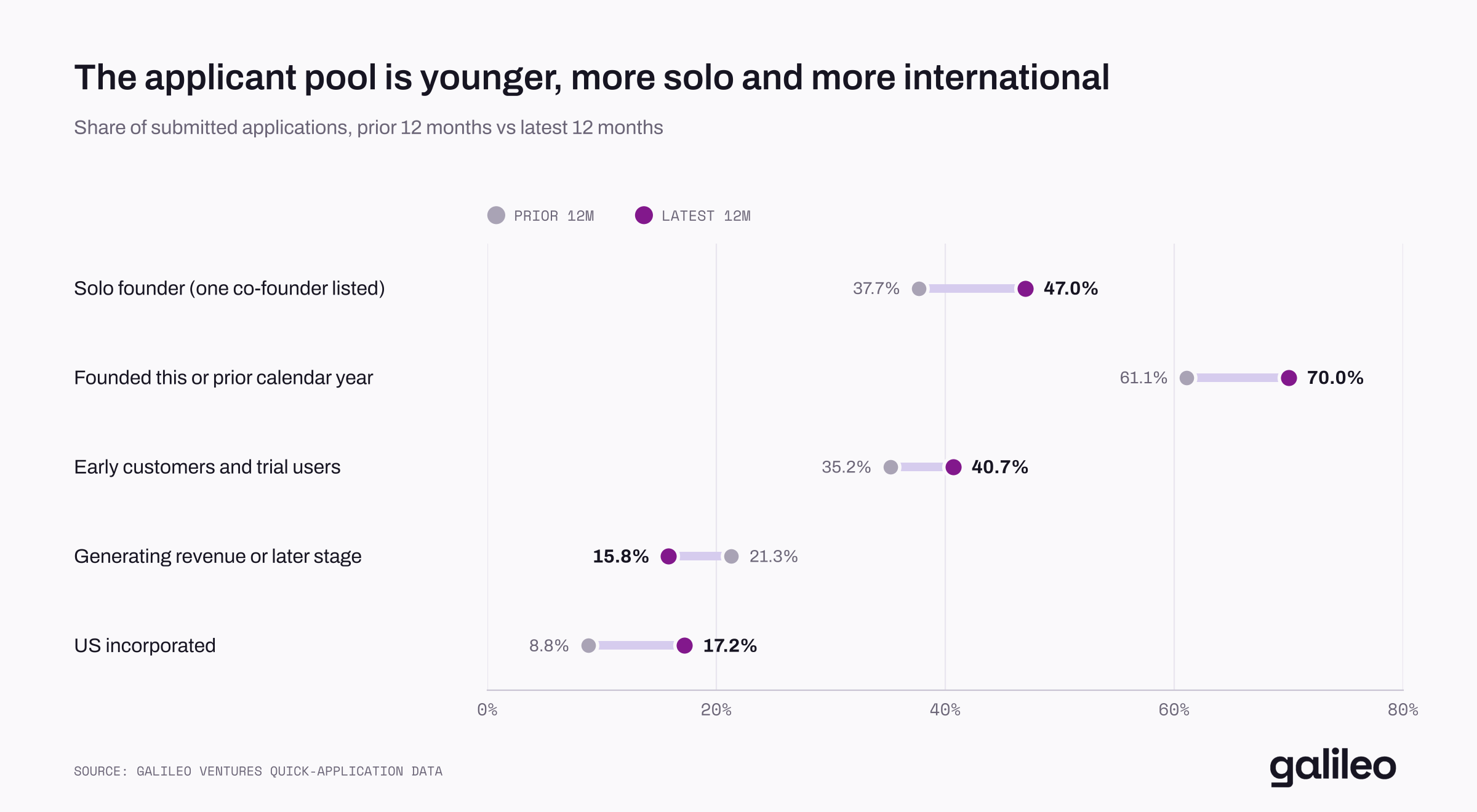
This year, we received over 550 applications (excluding over 500 cold inbound emails): twice last year and growing. Nearly two-thirds now mention AI in their product descriptions, compared with 13% in 2022.
More applicants report early users, although the traction story is more complicated than that. And 9% say they found Galileo through AI tools or LLMs, up from <2% a year ago.
The muddy moat of software
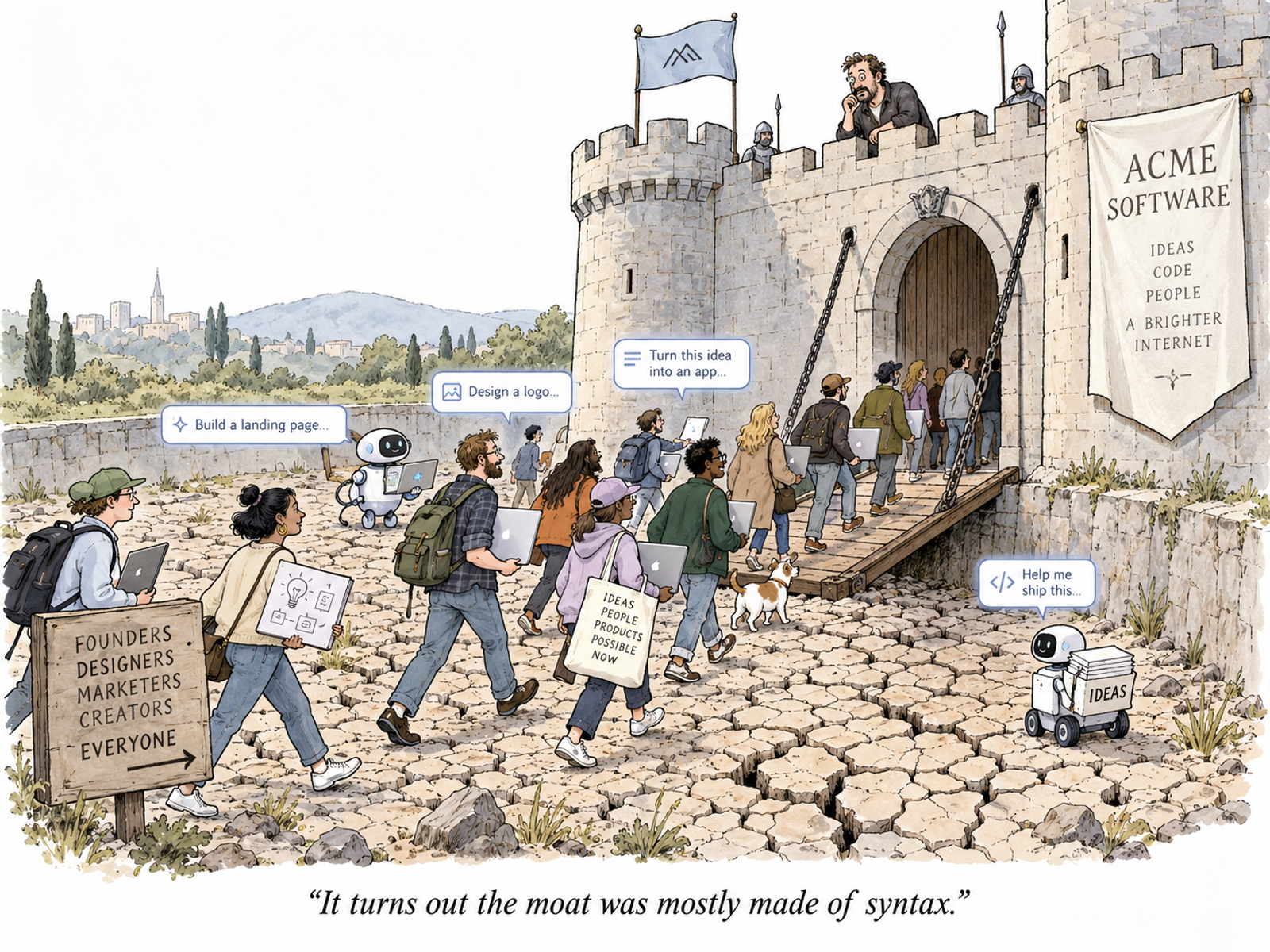
I used to say all you need is a laptop and an internet connection to build a business which is partly true. But there was a fairly big catch: you usually needed someone who could code (or learn to code). Building software used to be a rather deep moat, but now it’s just rapidly drying mud.
Today AI makes that first software, and maybe even hardware, product trivial to build. The AI-driven industrial revolution1 will create vastly more builders than prior upheavals. I think individual creativity will flourish in new and unexpected ways.
But if building and explaining an early product are getting easier, what gives us conviction to invest?
How do you cut through with your pitch?
What is an AI startup anyway?
Do you still need a CTO?
And are founders actually arriving with more traction?
Warm intros are for suckers; or why we take open applications seriously
Galileo has an open application, no warm intro required policy. We specialise in pre-seed and seed-stage emerging founders: first-timers, domain specialists and builders who haven’t raised venture capital before. Connections shouldn’t be a prerequisite for getting a look.
As a result we take our cold inbound applications as seriously as any others! We give feedback to everyone who applies online, with a no-ghosting rule.
At the same time, a lesson from being a VC for 6 years now is that this policy means reviewing them all takes a bit of time, and at times we take too long to get back to founders.
This analysis covers over 2,000 applications with most comparisons focused on the latest 12 months and the preceding year. I’m working on a bigger paper looking at the trends. If that interests you, send me a note!
Send us your AI slop, but don’t make it too sloppy
First of all, at Galileo we’re OK with AI-assisted pitches. We encourage them.
With thanks to Tobi (and also see Hugh’s post), just because you can lob an “AI slop grenade” doesn’t mean we’ll understand it. A pitch can be beautifully formatted and full of confident language, yet leave us guessing who the customer is or why they would care.
AI doesn’t automatically demonstrate clarity of thought, unique insight or capability. We still need to understand what you know about the problem and why you’re the person to solve it.
In our applications the median combined response length increased about 18% this year. I suspect AI plays a part, but length doesn’t tell us who wrote something. What matters is whether the extra words help us understand the business.
Here’s what I think are “good” ways to use AI in your pitch:
- Turning your thinking into a clear deck. For many pre-seed founders, that will be faster and better than doing the design themselves.
- Figuring out market size, M&A activity or other things VCs will typically do (we’ll verify data presented!)
- Analysing your actual growth and engagement data, with metrics you can explain.
- Working out if your pitch is ‘VC backable’ (pro-tip)
- Finding investors who fit, including whether Galileo makes sense for you.
And some of the red flags I have seen all too often now:
- Sending a pitch you can’t explain or defend, with claims you haven’t checked.
- Passing off generic AI output as a customer insight you’ve actually tested.
- Using AI to spam a bunch of investors cold with generic messages and subject lines like “Worth a chat” (hot tip: we ignore all these)
AI is also changing how founders find investors. An increasing number of founders name tools such as ChatGPT, Claude, Gemini, Perplexity or Grok; others refer to AI more generally. Like any other industry the ‘Answer Engine Optimisation’ is an important way founders discover which VCs to pitch (much like optimising your site for Google, there’s a whole practice dedicated to how to do this).
Is every startup an AI startup?
With nearly two-thirds of our applications mentioning AI, the label alone tells us less than it once did. Back in the dotcom boom, everyone wanted to invest in ‘internet startups’. Eventually, we needed a more useful description of what a company actually did.
So while it’s fine to mention AI in your pitch, if you’re building an ‘AI business’, we want to understand what that means.
A few questions worth asking (and answering):
- What can your customer now do that they couldn’t do before, or do substantially better?
- Does your product introduce a new workflow, behaviour or product category?
- What technical expertise does your team need to build and maintain it?
- Are you using an existing model, fine-tuning one or training your own? Why is that the right choice?
- Do you have unique data, and what makes it valuable?
- As frontier models improve, where does your product’s value come from?
- How do your economics change over time?
- Where do you sit in the stack: applications, data or infrastructure?
An application built on someone else’s model can still be a compelling business.
Most importantly for us, we want to understand where you see the customer value and why you’re well placed to deliver it.
Do you even need a CTO anymore?
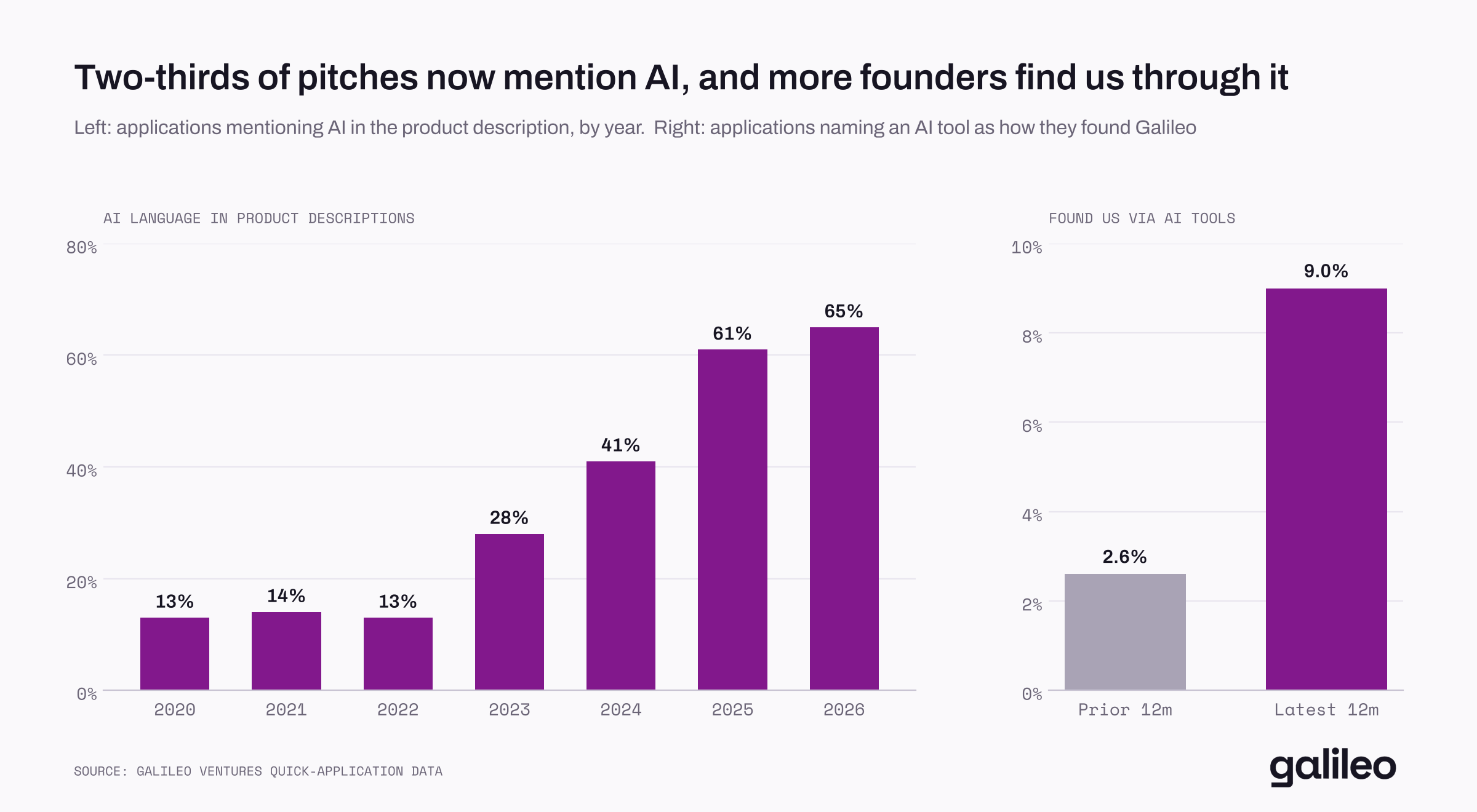
A whopping 47% of applications say they’re going it solo, compared to 37% the previous year. AI enables founders to just build, and not recruit a team or technical co-founder.
We think it’s fine to build early products and prototypes with AI, and we encourage it. But we want to see customer testing and product iteration moving along with the code!
The “write-code, talk-to-customers” loop will, I think, always hold true. Show us what you’ve learned and what you changed as a result. Iterate quickly.
For all the talk of one-person unicorns, I still prefer backing a strong co-founder pair who can execute and build the product. Building a lasting business means convincing great people to join your mission. AI shouldn’t stop you doing that.
That doesn’t mean a solo or non-technical founder should wait to speak to us. Starting a conversation and being ready for investment are different things.
When we consider investing, I want to understand who will own the technical decisions and how you’ll build the capabilities the business needs.
A few pointers for non-technical founders:
- Use AI to learn about engineering and understand what you’re building.
- Have a credible plan for technical leadership. If you need a CTO co-founder, show us how you’re approaching that search.
- Show us who you’ve convinced to work with you, and which skills you still need.
Are founders pitching us with more traction?
The short answer is yes but it is more mixed than I expected.
AI companies are setting new benchmarks for hitting 100m users and $1b revenue but at pre-seed we’re seeing mixed results. The share selecting ‘early customers and trial users’ rose from 35.2% to 40.7%. But the share selecting the later stages, from generating revenue through to growth and scale-up, fell from 21.2% to 15.8%.
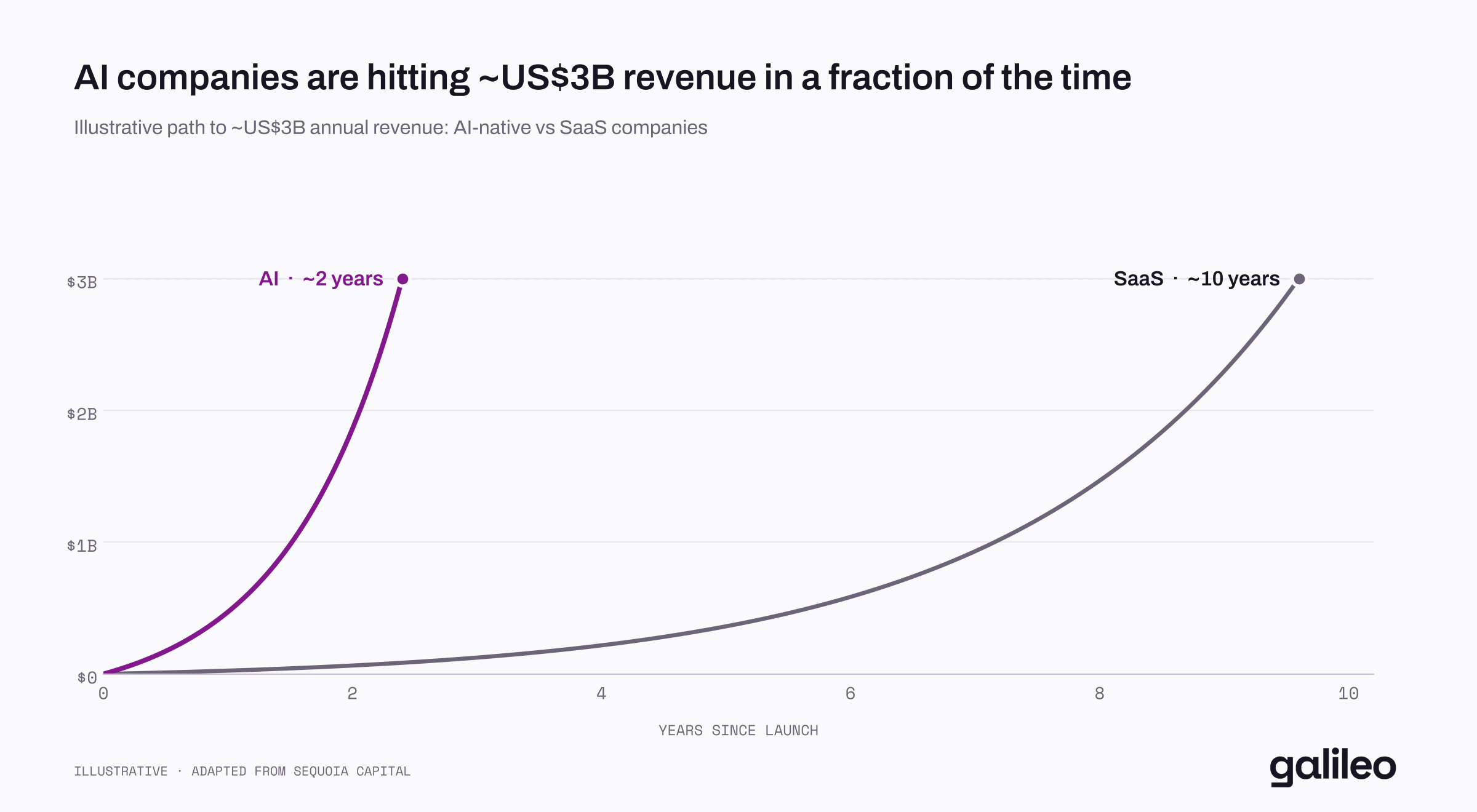
I’ve heard some investors say AI growth is ‘high churn’ growth. While the overall numbers are impressive, we’re still seeing a lot of users come and go. At pre-seed you still need to focus on ‘discovering’ what is useful for customers. And figuring out whether they’ll stick around and keep coming back.
AI should help founders:
- Build faster
- Launch earlier
- Trial with customers sooner, and
- Get more feedback, faster
All with less money and time than before.
What traction do you need before a VC invests?
“The bar” (in terms of traction needed for a VC to invest) has shifted much faster for software companies than for hardware companies. For software founders, building faster should create more opportunities to learn. Hardware companies have different development and testing constraints, so I wouldn’t apply the same timetable to them.
We don’t need lots of traction to start a conversation. We do want a compelling unique insight, evidence of learning and a team capable of taking the next steps. That’s how we build conviction about why you will win.
So where to from here? Founders: give us your worst best
While there’s a lot of AI doomerism going around, I am frankly so excited to see what happens next. I’ve never been as uncertain about the future while also optimistic about what it will bring. Its truely the best time to build!
Ask anyone who built companies through the dot com (“early internet”) era, the “social era”, or the “mobile era” that have come before — volatile times generate opportunities galore. I think the AI era will have a bigger impact than any of those three.
So, what are you waiting for? Apply now and get in touch. We want to back more crazy ambitious emerging founders with a big vision with Galileo Fund II and are waiting to hear from you!
Pitch me,
James
Managing Partner